
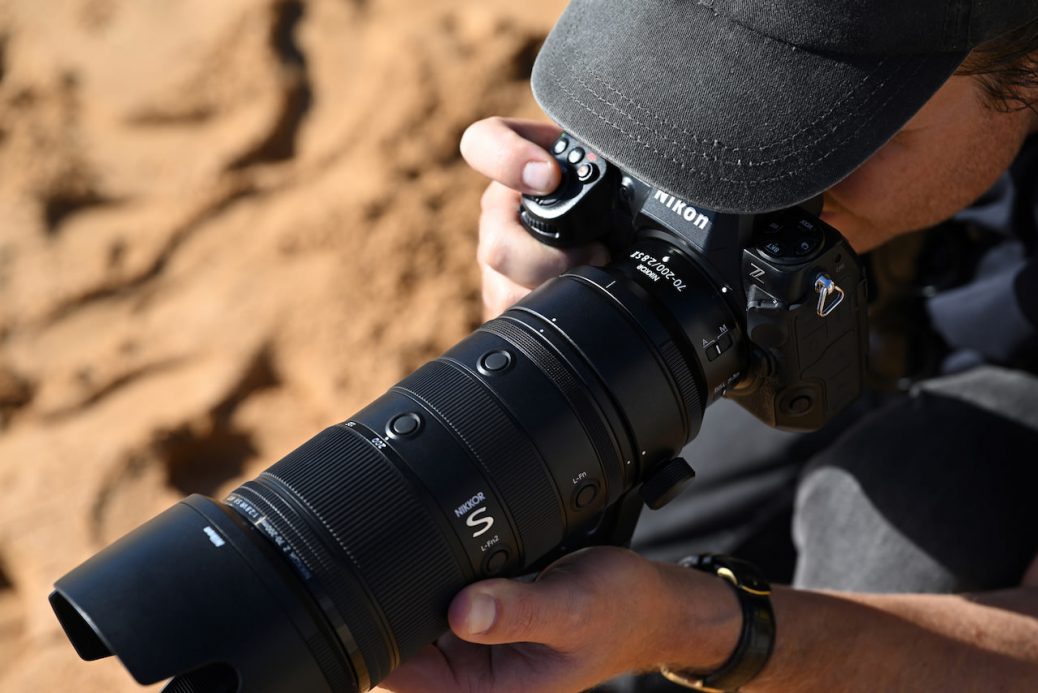
Nikon Announces Nikkor Z 70-200mm f/2.8 VR S II Telephoto Zoom
Nikon has announced the Nikkor Z 70-200mm f/2.8 VR S II, a second-generation version of its professional telephoto zoom for full-frame Z-mount mirrorless cameras. The lens replaces the original Z 70-200mm f/2.8 VR S introduced in 2020 and follows the recent update of the 24-70mm f/2.8 S, suggesting a broader revision of Nikon’s constant-aperture f/2.8 zoom lineup.
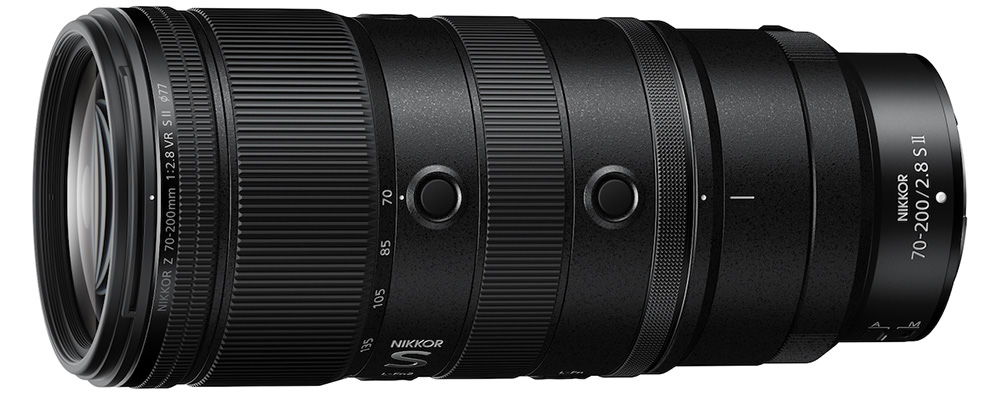
“This lens is a true demonstration of the optical superiority and expertise that Nikon pours into NIKKOR Z S-Line optics, giving professionals ultimate confidence in performance and reliability, day in and day out,” said Fumiko Kawabata, Sr. Vice President of Marketing and Planning, Nikon Inc.
The new model has been redesigned with a revised optical formula comprising 18 elements in 16 groups, three fewer elements than its predecessor. The construction includes Super ED, ED, aspherical ED, aspherical, fluorite, and SR (Short-wavelength Refractive) elements: according to the Japanese company, the reconfiguration reduces aberrations while contributing to weight reduction. The lens also incorporates Meso Amorphous and ARNEO coatings to limit ghosting and flare, along with a fluorine coating on the front element for resistance to moisture and contaminants.



A key change is the reduction in weight: without the tripod collar attached, the lens weighs 998 grams; with the collar installed, it weighs approximately 1,180 grams. The weight reduction of 26% compared to the previous model, which weighed 1,360 grams, is attributed to a modified front lens group and simplified moving mechanisms. The lens is dust- and drip-resistant and maintains professional-level weather sealing, and retains compatibility with Z Teleconverters TC-1.4× and TC-2.0×. Vibration Reduction is rated at up to six stops of compensation and can operate in conjunction with in-body stabilization on compatible cameras via Synchro VR.
Autofocus is driven by Nikon’s “Silky Swift” voice coil motor (VCM) system. The company reports that autofocus acquisition is up to 3.5 times faster than the first-generation lens, with improved tracking performance during zooming and reduced operational noise. A focus position sensor is also included to improve precision. The minimum focusing distance is 0.38 meters at 70mm and 0.8 meters at 200mm, offering a maximum reproduction ratio of 0.3× at the wide end and 0.25× at the telephoto end.
The aperture range remains f/2.8 to f/22, but the diaphragm now uses 11 rounded blades instead of nine: Nikon indicates this change is intended to produce more circular out-of-focus highlights across a wider aperture range. The zoom mechanism is internal, maintaining consistent balance during focal length changes, which is relevant for handheld shooting and gimbal use.
Ergonomic updates include a removable tripod collar with an integrated Arca-Swiss-compatible foot, marking the first time a Nikkor lens has incorporated this feature directly. The programmable control ring can be set to clicked or de-clicked operation, allowing either tactile feedback for still photography or smooth adjustment for video. Two sets of customizable function buttons are positioned for use in both landscape and portrait orientations. The supplied lens hood includes a filter adjustment window to enable rotation of circular polarizers or variable ND filters without removing the hood.
Here are some sample pictures, courtesy of Nikon:









The Nikkor Z 70-200mm f/2.8 VR S II is scheduled for release in late March 2026. In the United States, it will retail for approximately $3,199.95, representing an increase over the original model’s launch price of $2,896.95. In the United Kingdom, pricing is set at £2,999, and in Australia at AU$5,399.