
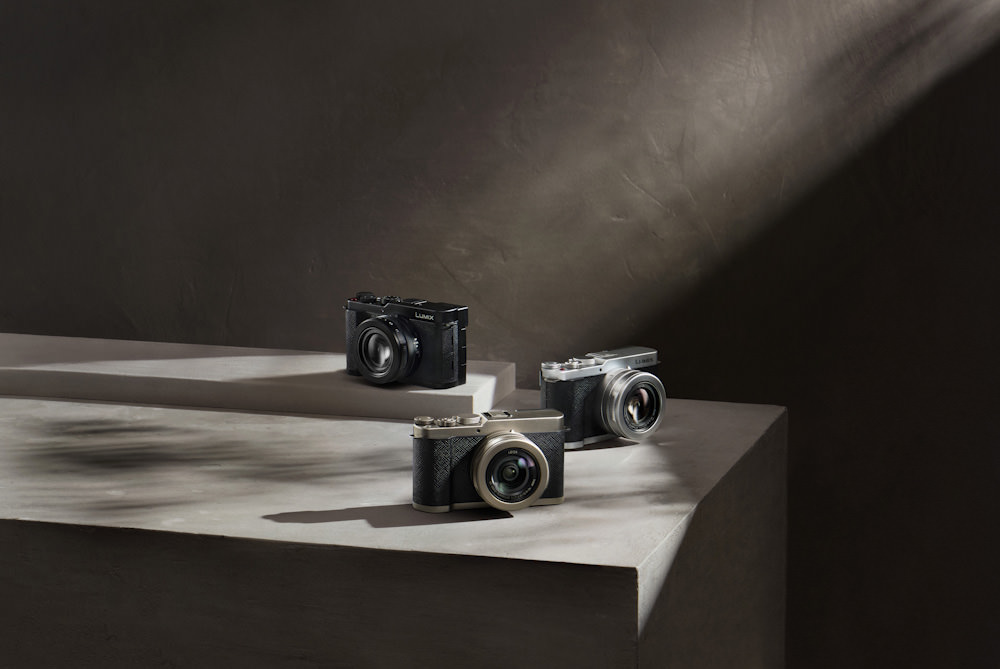
Panasonic Celebrates 25 Years of Lumix with Fixed-Lens L10
Japanese company Panasonic announced the Lumix L10, a fixed-lens compact zoom camera intended as a continuation of the LX100 series lineage, released to mark the 25th anniversary of the Lumix brand.
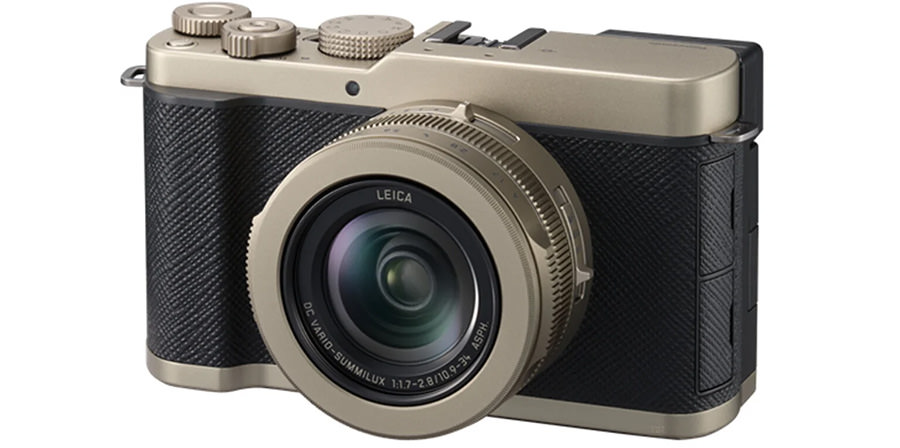
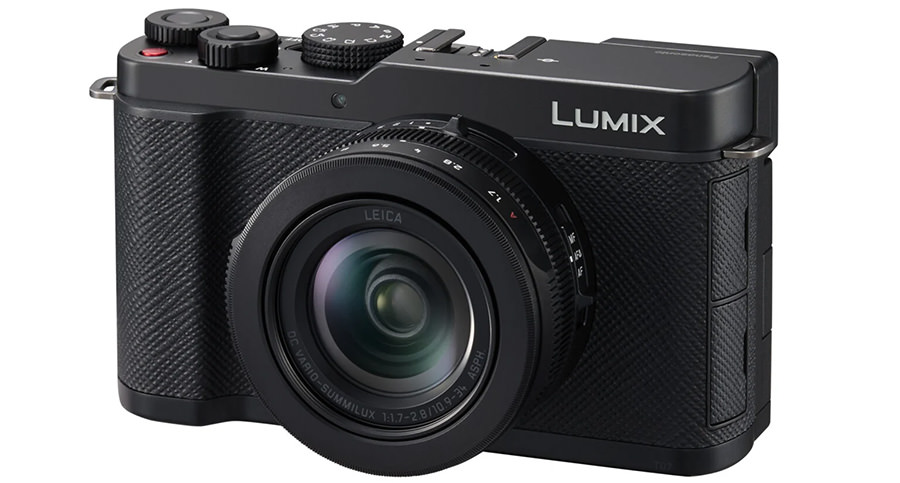
The body of the LumixL10 weighs 508 grams including battery, SD card, and hot shoe cover, with dimensions of 127.1 × 73.9 × 66.9 mm. Construction uses a magnesium alloy front case with a metal exterior finished in a saffiano leather texture, and the camera is available in Black and Silver, with a limited Titanium Gold Special Edition — the latter bundled with a dedicated lens cap, leather strap, lens cloth, and commemorative shutter button for launch purchasers.
The imaging core centers on a 20.4-megapixel backside-illuminated Micro Four Thirds CMOS sensor, identical to the one used in the Lumix GH7, with a total pixel count of 26.5 megapixels. The sensor is larger than the lens image circle, which allows the camera to maintain a consistent angle of view across 4:3, 3:2, and 16:9 aspect ratios without altering framing when switching between them — an approach carried forward from the original LX100. A physical selector dial on the lens barrel provides direct access to aspect ratio modes. Dynamic Range Boost is available for still capture to extend shadow detail, though no measured dynamic range figure in stops is provided in the announcement materials.
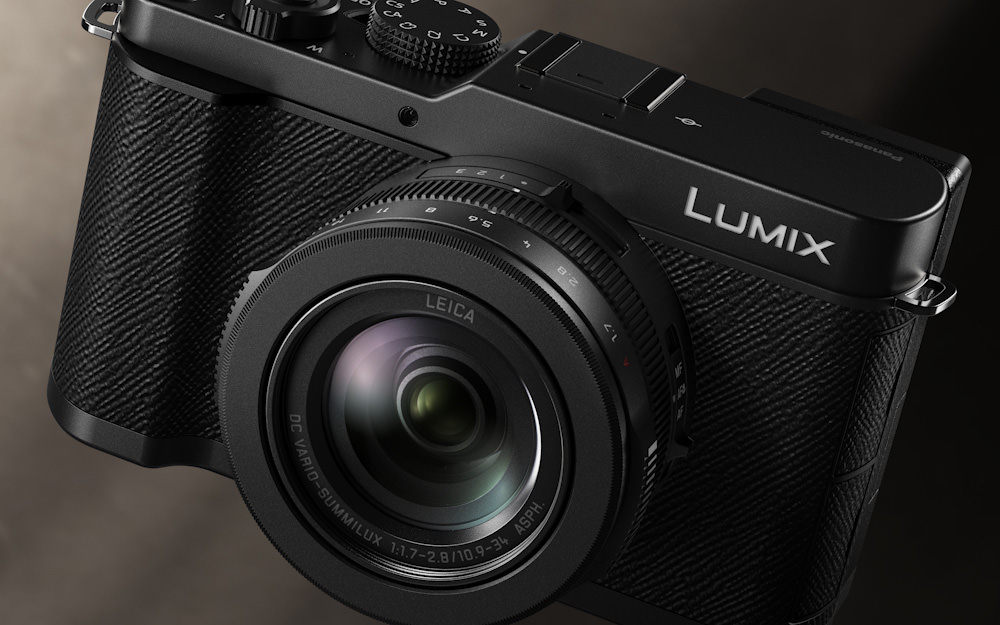
In front of the sensor sits a Leica DC Vario-Summilux lens covering 24–75mm full-frame equivalent, with a maximum aperture range of f/1.7–2.8. The optical formula comprises 11 elements in 8 groups, including 5 aspherical lenses across 8 aspherical surfaces, with a 9-blade aperture diaphragm. A manual aperture ring is built into the lens barrel.
Autofocus uses Panasonic’s Phase Hybrid AF system with 779 focus points, combined with AI-based subject recognition covering eyes, faces, bodies, animals, vehicles — including cars, motorcycles, trains, and aircraft — and what Panasonic categorizes as Urban Sports scenes. AF sensitivity is rated from EV -5 to 18 at f/1.7 and ISO 100 in single-shot AF. Minimum focusing distance for AF macro is 3 cm at the wide end and 30 cm at the telephoto end. Continuous shooting reaches 30 frames per second with the electronic shutter, including a pre-burst SH30 PRE mode, and approximately 11 frames per second with the mechanical shutter. Stabilization is handled by Panasonic’s Power OIS system.
The viewfinder is a 2.36-million-dot OLED unit at 0.39 inches with 0.74× equivalent magnification and a 20 mm eye point. The rear monitor is a 3-inch free-angle TFT panel with 1.84 million dots and touch input, with a UI that adapts dynamically between horizontal and vertical orientations. Battery life is rated at approximately 420 frames using the rear monitor and 410 using the EVF under CIPA standards, rising to around 1,000 in Power Save LVF mode. The battery is the DMW-BLK22 at 7.2V, 2200 mAh.
On the video side, the L10 records in MOV up to 5.6K open-gate at 30p in 4:2:0 10-bit, DCI 4K at up to 120p in 4:2:0 10-bit, and Full HD at up to 240p. All-Intra codecs reach up to 600 Mbps. V-Log is included, with a claimed latitude of 13+ stops at output rates below 60fps and 12+ stops at 61fps and above. A dedicated MP4 Lite mode provides 4K and Full HD recording at reduced bitrates for direct social sharing. The camera has a 3.5mm microphone jack but no headphone output. It also supports the DMW-XLR2 adapter for four-channel audio up to 32-bit float at 96kHz with a compatible microphone.
Color science additions include two new Photo Styles: L.Classic, described as delivering soft tones and muted colors, and L.ClassicGold, characterized by warm amber highlights and heightened contrast. Real Time LUT support allows up to two LUTs to be loaded and previewed simultaneously during shooting, using .vlt or .cube files. A dedicated LUT button is present on the body.
The L10 is the first camera to ship with full compatibility with Lumix Lab version 3.0.0, which becomes available on May 20, 2026. The updated application introduces RAW editing, Slow & Quick video editing from a smartphone, a revised UI, and the ability to push firmware updates to compatible cameras directly through the app without requiring a computer or SD card transfer. Compatible cameras at launch include the DC-S1RM2, DC-S1M2, DC-S1M2ES, DC-S5M2, DC-S5M2X, DC-S9, DC-GH7, DC-G9M2, and DC-L10. Features exclusive to the L10 and the updated S9 include wired USB-C camera-to-phone connection for faster file and LUT transfers, the ability to edit My Photo Style within the app, and in-camera LUT creation with parameters for grain, color noise, sharpness, and noise reduction via Real Time LUT.
Connectivity covers USB-C at USB 10Gbps with support for in-camera charging, data transfer, and UVC-compliant livestreaming, alongside Wi-Fi (2.4 and 5 GHz, 802.11 a/b/g/n/ac) and Bluetooth 5.0 BLE. Storage uses a single SD/SDHC/SDXC slot with UHS-II and Video Speed Class 90 support.

The Lumix L10 ships in June 2026. Black and Silver variants are priced at $1,499 USD and €1,499.99, available through standard retail channels. The Titanium Gold Special Edition carries a $1,599 USD price tag and is distributed primarily through the official Panasonic Store, with availability varying by region.